


Price : $22.13
You Save : $8.25 (27%)

Product Description
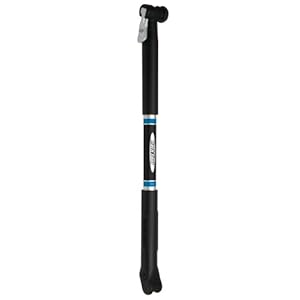
One size does fit all. A full-length frame pump that securely locks into nearly any frame. The PMP-5 quickly adjusts (no tools needed) to fit small to large size frames so riders can use one pump for multiple bikes and retailers can stock just one frame pump. All aluminum barrel construction ensures long life and fluid operation. The PMP-5 is Presta and Schrader valve compatible and features a dual density, soft touch flip-out handle for smooth, comfortable pumping. One pump, multiple bikes, fast and easy! (Max. pressure: 160 psi / 11 bars) Patents pending
Product Details
- Product Dimensions: 22 x 6 x 2 inches
- Shipping Weight: 12 ounces (View shipping rates and policies)
- Shipping: This item is also available for shipping to select countries outside the U.S.
- Shipping Advisory: This item must be shipped separately from other items in your order. Additional shipping charges will not apply.
- ASIN: B00113JAG0
- Item model number: PMP-5
Product Features
- The PMP-5 quickly adjusts (no tools needed) to fit small to large size frames
- All aluminum barrel construction ensures long life and fluid operation
- The PMP-5 is presta and schrader valve compatible and features a dual density
- One pump, multiple bikes, fast and easy
- Maximum pressure: 160 psi / 11 bars
Park Tool PMP-5 Dial Adjust Frame Pump
Customer Reviews
In case you're not convinced to get a frame pump vs. the other options, when I started riding as an adult, I bought and used a mini-pump for the better part of a year. When I upgrade by bike to a good road bike, I bought a Zefal hpx 3 (the "3" is an indicator of the size), and never looked back. Although I looked at the new-fangled CO2 pumps, I was never convinced that they offered any advantages. Some book I read at some time recommended a full size frame pump, saying you'll be the hero of a group ride when someone has a flat, and a rider is attempting to pump a tire with a mini-pump. That's for real, and similar things have happened to me on special event rides when I ride up to a cyclist standing along the side of the road with three expended CO2 cartridges lying at his feet along with his still-flat tire.
With an actual pump, you never wonder if you have enough cartridges with you, or realize that you need more before a ride because you forget that you used your last one the last ride. As for a full size pump over a mini-pump, people buy the minis because they weigh less. The few ounce difference between a mini and full size pump might amount to seconds over a century or stage race. If you're racing at the level where a few seconds count, you don't have a pump. A mechanic rides up next to you in a team car and swaps your wheel. For the rest of us, I don't see any reason not to carry a full size frame pump.
That being said, my Zefal hpx seems to be the gold standard by which frame pumps are judged. It has served me well for the last ten years, and many hundreds of pumped tires. Even when searching for recommendations of frame pumps today, the hpx seems to come out on top across the internet. However, I have been told by a couple of different dealers now that there has been no US Zefal distributor in the last few years, so parts are nearly impossible to come by. The hpx has replaceable plastic "wings;" the little concave braces that fit against the bike's tubing. These flex and eventually break with years of use. I lost one years ago, and the other is about to break. Although the pump still works perfectly, I decided to look at other options instead of ordering parts from Europe. Naturally, I am going to use the hpx as a standard for comparison.
There do not seem to be many frame pumps on the market. Based on my experience with Park Tools, and their good reputation, I got the PMP-5. Unlike the Zefal hpx's, which came in fixed sizes, the PMP-5 is adjustable to a wide range of bikes.
I was unable to compare the PMP-5 against my bike before getting it. I had hoped that it would fit along a seat stay, keeping it out of the way. Unfortunately, on its shortest setting, it came up a fraction of an inch too long. I think this is an ideal place for a frame pump, out of the way of bottles, headlight batteries and other things that populate the main frame triangle.
The length adjustment mechanism consists of a plastic chevron on the cylinder cap that slides into one of eight side slots off of a central slot on the pump handle. When handling the pump, it's easy to move the chevron out of the desired adjustment, and you must take it out of the desired slot to unfold the handle for use. So you have to be careful to hold it in the desired position until you get it on the bike, at which time everything is held together under the spring tension. I would like to see an adjustment method that locked down some how, but this is a workable solution.
The handle folds out to about 100 degree angle from the pump body, and an over center mechanism snaps it into place. My hpx does not do this, and this is a very nice, hand-friendly feature. Now if only they could do that at the pump head end, too.
The materials and construction are comparable to those on the hpx. Since they worked fine on the hpx for ten years (and I imagine would go on for another ten easily), I have little doubt that the parts will last for a long time. And I hope that Park, being a domestic company, will have replacement parts readily available. One nice upgrade of the Park over the Zefal is that that piston shaft is anodized. Despite my attempts to keep the one on the hpx greased, its shaft is quite corroded.
The PMP-5 has deep, wide, rounded grooves on the end of the folded handle and pump head to brace against the tubing. These seem to conform to my bike frame better than the hpx ever did. The ends of the pumps are offset from the center of the pump body so that the body clears cable fittings, battery pack straps, and other things that may be on a top tube. And there are no "wings" to break off and then have to order from Europe.
I have used the PMP-5 a number of times already. After years of using the hpx 3, the stroke felt short to me. But then, I just complained that the PMP-5 was longer than I liked. I compared them side-by-side, and interestingly, the Park has a longer cylinder body than the Zefal. However, the Zefal DID have a longer stroke. It makes me wonder what all the space near the pump head in the Park was doing. The Park cylinder is slightly larger in diameter than that of the Zefal, so actual volume with each stroke is probably similar.
Finally, there is the issue of maintenance. Eventually, you'll want to add a little oil inside the cylinder to seal the O-ring. The Park PMP-5 requires that you remove a tiny set screw with a jeweler's screwdriver. It's not hard to remove if you have the appropriate tool, but certainly not as nice a solution as the screw-off cap of the hpx that could be removed with little more than your bare hands.
I am sad that my perfectly functioning hpx will be relegated to the parts box to await some possible future use, but I suspect that the Park PMP-5 will serve me just as well for as long or longer.
I finally had to scrap my Zefal HP-X4 frame pump because it
cracked where the aluminum cylinder was crimped to the valve body.
(it lasted me about 20 years ... over the years, I changed the piston cup one time).
I decided to give this Park Tools pump a try, seeing that it was
a bit cheaper/more modern than the Zefal (which is getting difficult to find).
Pros:
- nice styling and quality of construction seems good.
- fits into the frame and stays in place much better than the Zefal.
(The Zefal fell out when going over bumps and the plastic ears cracked,
making things worse)
- It is easy to adjust to get the correct length to fit my frame.
- The swing-away pump handle gives good leverage when folded for pumping.
Cons:
- No knurling on the front handle, makes it slippery to hold onto
when filling tires.
- The throw on it is a bit shorter and it seems to require more force
to pump a tire up.
- It can be difficult to get the pump to fit all the way onto the Schrader valve
stems and press down enough to push the valve in adequately.
If the pump head is not pushed far enough on, the valve pin is not pushed in
enough and the pump is extremely hard to push, and almost impossible to fill the
tire. Maybe they need to make the pin in the pump head a bit longer so it pushes
on the valve core a bit more..? This is no big deal, but it does take longer and
more work to make sure that the pump head is pushed hard onto the valve
before clamping it down. This can be difficult when a tire is flat and the stem
is already starting to push into the rim hole.
UPDATE: SLIGHTLY LOOSENING the BIG NUT at the end of the pump will allow the
pump to fit more easily over the schrader valve... making it MUCH easier to
use this pump.


0 comments:
Post a Comment